

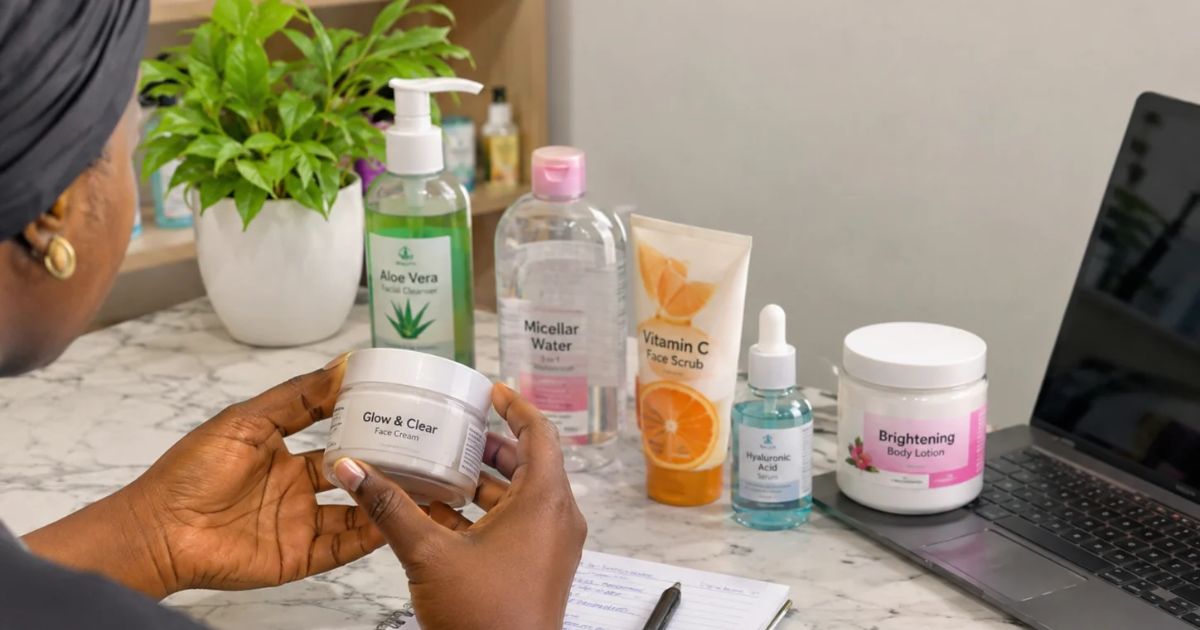
To start a skincare brand in Nigeria, pick a focused niche, choose your production model (private label, contract manufacturing, or small-batch), register your business with the CAC, register every product with NAFDAC, label it correctly, and price it for profit before selling on Instagram, WhatsApp, and online stores. NAFDAC registration is non-negotiable, since selling unregistered cosmetics can lead to confiscated stock, fines, and closure. This guide walks you through each step using the 3-Gate Launch Method: Legal, Safe, and Sellable.
How Do You Start a Skincare Brand in Nigeria?
To start a skincare brand in Nigeria, pick a focused niche, choose how you’ll produce your products, register your business with the CAC, register each product with NAFDAC, label it correctly, price it for profit, and sell through channels like Instagram, WhatsApp, and online stores. Skipping NAFDAC puts your whole business at risk.
What It Takes to Start: The 3-Gate Launch Method
The 3-Gate Launch Method is a framework that splits your launch into three checkpoints. You don’t open the next gate until the last one is done.
- Gate 1: Legal. Register your business and your products.
- Gate 2: Safe. Make a stable formula with clean ingredients and honest labels.
- Gate 3: Sellable. Price, brand, and sell.
Every step below belongs to one of these gates, so you always know where you are.
Is a Skincare Business Profitable in Nigeria?
It can be, but profit depends on your pricing and your costs, not just on demand.
Some guides quote margins as high as 40% to 80%, but they rarely show the math or the source. Treat those numbers with care. Your real margin depends on your ingredients, packaging, NAFDAC costs, marketing spend, and what the naira does against the dollar.
The good news is that you control most of these. Later in this guide you’ll find a simple pricing formula so you can work out your own margin before you spend money.
Step 1: Pick Your Niche and Your Customer (Gate 3 groundwork)
“Skincare for everyone” is a weak starting point. A focused niche is easier to market, easier to formulate, and easier to remember.
Start with one problem and one person. For example:
- Dark spots and uneven tone on melanin-rich skin
- Dry, ashy skin during harmattan
- Acne-prone teenage skin
- Gentle, fragrance-free care for babies or sensitive skin
The strongest Nigerian skincare brands grow from a clear point of view, often built around local ingredients and real skin concerns, not from trying to sell everything.
Think small on your first launch too. Begin with one or two products. This lets you test demand, control costs, and sharpen your message. A cleanser and a moisturizer, or one serum, is plenty.
Quick exercise: Write one sentence: “My helps [specific person] with [specific problem].” If you can’t finish it, your niche is still too broad.
Step 2: Choose Your Production Model (Gate 2)
This is the biggest decision you’ll make. There are three common paths.
| Model | How it works | Best for | Main risk |
| Private label | A manufacturer makes a ready formula and you add your brand | Fast, low-risk launches | Less unique formula |
| Contract manufacturing | A lab makes your own custom formula | Brands with a clear signature product | Higher cost and minimums |
| DIY / small-batch | You or a formulator make it yourself | Very small budgets | Safety, consistency, scaling |
A few notes on each path:
- Private label cuts development time. It uses pre-developed, tested formulas that can be customized to your brand, which lowers cost and risk for first-time founders.
- Contract manufacturing suits you once you know exactly what product you want to own. You get a custom formula, with higher minimums and cost.
- DIY works only if you take safety seriously. If you lack a chemistry background, hire a cosmetic formulator, because a bad reaction can damage your reputation overnight.
Where Soneri Care fits: Soneri Care (Picardy) supports Nigerian brand owners with private label and third-party cosmetic manufacturing, so you can launch under your own brand without building a factory or lab. If you want to explore this route,.
Plain-English tip: If you’ve never made skincare before, start with a private label or a trained formulator. You can always move to a custom formula once you have sales.
Step 3: Register Your Business with the CAC (Gate 1)
Before anything else, make your business official.
- Choose a business name that’s unique and easy to say.
- Register it with the Corporate Affairs Commission (CAC) as a business name or a limited company.
- Keep your certificate safe. You’ll need it for NAFDAC.
This isn’t optional busywork. For micro-scale businesses, CAC registration comes first, before you can register with NAFDAC.
If you plan to hire staff, take investors, or grow big, a limited company is usually the stronger choice. A simple business name is faster and cheaper for a solo start. Check the current CAC requirements on the CAC website before you apply.
Do You Need NAFDAC Registration? How It Works (Gate 1)
Yes. If you make, import, advertise, or sell skincare in Nigeria, your product must be registered with NAFDAC.
NAFDAC is the National Agency for Food and Drug Administration and Control. It regulates cosmetics in Nigeria, including creams, lotions, serums, and soaps.
Alpha Arbutin Whitening Beauty SoapThe rule is clear. NAFDAC’s guidelines state that no cosmetic product may be manufactured, imPapaya Whitening Herbal Soapported, exported, advertised, sold, or distributed in Nigeria unless it has been registered.
And the risk is real. Marketing an unregistered cosmetic is unlawful, and unregistered products can be confiscated, with penalties, closure of premises, and even prosecution in serious cases.
Enforcement is not theoretical
In August 2026, NAFDAC’s cosmetics enforcement team ran a two-day operation at the Lagos Trade Fair Complex to remove unregistered cosmetic products. If you plan to buy ingredients, packaging, or stock from busy trading hubs, registration protects your brand from being caught in a crackdown.
How the process works
- Create an account on NAPAMS. Cosmetics applications are submitted online through NAFDAC’s NAPAMS portal, with no paper route.
- Prepare your documents. These typically include your CAC papers, product details, and lab evidence. Reports mention certificates of analysis for raw materials and finished products, and health certificates for production staff. Requirements differ for locally made and imported products, so always check NAFDAC’s current checklist.
- Prepare your labels. NAFDAC has specific labeling rules (see Step 6).
- Submit and pay. Fees depend on how many products you register. A 2024 report listed ₦15,000 for a single product, ₦5,000 per variant, ₦29,700 for two to five products, and ₦103,950 for more than five. Those are 2024 figures, so confirm the current fees on the portal before budgeting.
- Inspection and sample analysis (where required). Facility checks and lab testing may apply depending on your route.
- Approval and number. Once approved, you receive a NAFDAC registration number to print on your label.
How long does it take? It depends on your product, your documents, and the agency’s workload. One report put the final approval-and-number stage at roughly 20 days, but that doesn’t include preparation or lab steps. Plan for months, not weeks, and start the paperwork while you finish your formula.
Heads up: A 2026 bill in the Senate would repeal the current food and drug registration laws if passed. The practical rules could shift, so check NAFDAC’s website for the latest before you file.
Starting small is allowed
You don’t have to register a huge range at once. Start with a few products and register gradually. That fits the “start with one or two products” advice from Step 1.
Banned Ingredients to Avoid (Gate 1 and Gate 2)
If your brand focuses on brightening or “even tone,” pay close attention here.
Some skin-lightening ingredients are dangerous or banned. Many lightening and “glow” products rely on mercury, hydroquinone, or corticosteroids. NAFDAC also warns consumers about betamethasone, hydroquinone, and mercury.
Here’s what changed over time. NAFDAC first allowed up to 2% hydroquinone in skin-lightening cosmetics, but later banned its use. And Nigeria bans the importation of cosmetics containing mercury.
What this means for you:
- Never add mercury compounds, hydroquinone, or steroids to a cosmetic.
- Be careful with suppliers selling “strong” bleaching bases.
- Describe your products honestly (see Step 6). Words like “whitening” can attract extra scrutiny.
- If you want a brightening product, ask your formulator about safer, permitted ingredients and check NAFDAC’s current restricted list.
A single fake or unsafe product can end your brand and hurt a customer. This is one corner you never cut.
Step 4: Formulate for Nigerian Skin and Climate (Gate 2)
A formula that works in a cool lab can fail in a hot Lagos shop or a dusty Kano market. Build for real conditions.
What to plan for:
- Heat and humidity. Creams can separate, go rancid, or grow mold if the formula and preservative aren’t right. Ask your formulator about stability testing.
- Melanin-rich skin concerns. Hyperpigmentation, dark marks after acne, and dryness are common priorities. Your claims and ingredients should match real needs.
- Gentle first. Fewer, well-chosen ingredients are easier to test and safer for sensitive skin.
- Patch testing. Test on a small group before a wider launch.
You can also build on local ingredients like shea butter, but source them cleanly. Raw shea butter needs proper filtering and storage, or it can carry dirt and spoil faster.
Sample before you scale. Skipping sampling is one of the most common mistakes new skincare founders make. Check texture, scent, absorption, and how the product holds up over weeks.
Step 5: Source Packaging and Raw Materials (Gate 2)
Where you buy affects your cost, quality, and risk.
Common sourcing options:
- Local markets. Trade Fair in Lagos and Ariaria Market in Aba are known hubs for raw materials.
- Imported packaging. Some brands import distinctive packaging from overseas suppliers to stand out on a crowded shelf.
- Local alternatives. Forex swings affect the cost of imported packaging, and some founders reduce the risk by using local options like locally refined shea butter and beeswax.
- Through your manufacturer. If you go private label, your manufacturer can often guide you on compatible packaging and raw materials, which saves sourcing time.
Buying tips that save money and stress:
- Ask for samples before bulk orders.
- Keep invoices and supplier details. NAFDAC may ask for ingredient proof.
- Choose packaging that protects the formula (pump bottles and tubes keep fingers out of creams).
- Leave a price buffer. If you import, the naira can move before your order arrives.
Step 6: Label Your Products Correctly (Gate 1 and Gate 2)
A label isn’t just design. It’s a legal document.
What a compliant label generally includes:
- Product name
- NAFDAC registration number
- Ingredient list, using INCI names
- Net content in metric units
- Manufacturer name and address
- Batch number and expiry or manufacturing date
- Directions for use and warnings
NAFDAC’s rules back this up. Cosmetics must show a valid NAFDAC number before sale, ingredients should follow INCI naming, and claims must be scientifically substantiated. The 2019 labeling regulations also require the net content to be declared in the metric system on the inner and outer label.
Watch your claims
Cosmetics can’t promise to treat or cure disease. Medical claims are not allowed on cosmetic products.
| Risky claim | Safer wording |
| “Cures acne” | “Helps keep skin clear and balanced” |
| “Removes dark spots permanently” | “Helps even the look of skin tone” |
| “Treats eczema” | “Soothes dry, irritated-looking skin” |
When in doubt, ask NAFDAC or a regulatory consultant to review your label before printing 5,000 of them.
How Much Does It Cost to Start a Skincare Brand in Nigeria? (Gate 3 planning)
There’s no single answer, and sources disagree. That’s honest, so here it is plainly.
- One Nigerian business outlet estimates an initial investment of ₦500,000 to ₦5 million, depending on scale and product range.
- Another puts typical beginner skincare brands at ₦250,000 to ₦800,000.
The gap comes from what’s included. A tiny home-based launch is very different from a branded multi-product line with professional manufacturing.
Where your money actually goes
| Cost area | What to budget for |
| Business registration | CAC registration |
| Product registration | NAFDAC fees (check current rates), plus lab tests where required |
| Formulation / production | Formulator fees, private label order, or raw materials |
| Packaging and labels | Bottles, jars, boxes, printed labels |
| Branding | Logo, photography, a simple website or store |
| Marketing | Samples for creators, content, ads |
| Buffer | Money for reprints, reformulation, and price changes |
Your move: Get at least three written quotes for each big line (formulation, packaging, labels). Fill in your own numbers. Quotes beat guesses every time.
Tip: Don’t spend your whole budget on stock. Keep some for NAFDAC steps and for marketing. A beautiful product that can’t be legally sold, or that nobody sees, earns nothing.
Step 7: Price for Profit (Gate 3)
Many new brands price by guessing or by copying a competitor. Use math instead.
The simple formula:
- Cost per unit = ingredients + container + label + box + share of testing/registration
- Add your running costs per unit (marketing, delivery, payment fees)
- Set your price so the leftover covers your profit goal
Hypothetical example (not real data, for illustration only): Say a cream costs you ₦2,000 to make, pack, and label. Delivery and payment fees add ₦500 per order, and you spend ₦700 on marketing per sale. Your real cost is ₦3,200. If you sell at ₦6,000, your profit is ₦2,800 per unit, or about 47% of the price.
Now suppose packaging gets 20% more expensive because of the exchange rate. Your cost rises and your profit shrinks. Build a buffer of at least 10–20% into your price so currency swings don’t wipe you out. (That buffer is a planning rule of thumb, not a regulation.)
Pricing mistakes to avoid:
- Forgetting delivery, packaging, and payment fees
- Underpricing to compete with big brands
- Leaving out the cost of free samples and giveaways
Step 8: Build Your Brand and Protect It (Gate 3)
People buy skincare they trust. Your brand is how they decide.
Build the basics:
- A clear name that’s easy to spell and available on Instagram and as a web domain.
- Packaging that fits your price. Clean and simple often beats flashy.
- A consistent voice. Decide whether you’re luxury, fun, natural, or science-based, and speak that way everywhere.
Protect it: Once you have a name you love, consider registering it as a trademark so nobody else can copy it. Check the current process and fees with Nigeria’s trademark registry or a qualified IP lawyer before you invest in printing.
Step 9: Sell: Instagram, TikTok, WhatsApp, Marketplaces, and Payments (Gate 3)
Now you have a legal, safe product. Time to find customers.
Where Nigerian skincare brands commonly sell:
- Instagram and TikTok. Social platforms let small indie brands compete with big names, and micro-influencers can drive discovery.
- WhatsApp. Perfect for repeat customers, restock alerts, and personal advice.
- Your own online store. A local payment gateway makes checkout smoother for customers.
- Marketplaces and pharmacies. These usually expect a valid NAFDAC number.
- Pop-ups and events. Meeting customers face to face builds trust fast and often becomes a turning point for small brands.
Easy ways to build trust:
- Share your NAFDAC number openly.
- Post ingredient lists and how-to-use videos.
- Collect honest customer photos and reviews.
- Send samples to creators who match your niche, and ask for honest feedback.
What Your First 90 Days Could Look Like
For the brand owner: replace this block with your real launch story, numbers, and photos. First-hand experience is one of the strongest trust signals you can add. The outline below is a sample plan, not data.
| Window | Focus |
| Days 1–15 | Pick niche, decide production model, register with CAC, request quotes |
| Days 16–45 | Finalize formula and samples, start NAFDAC application, design labels |
| Days 46–70 | Order packaging, run patch tests, build your page and content |
| Days 71–90 | Finish registration steps, soft launch to a small audience, collect feedback |
Real timelines will vary, especially for NAFDAC. Adjust to your situation.
Mistakes That Sink New Skincare Brands
- Selling before registering. It’s the fastest way to lose stock and trust.
- Launching too many products. More products means more testing, more labels, and more money tied up.
- Ignoring stability. A cream that melts or separates in the heat costs you customers.
- Using banned or risky ingredients. It can hurt people and end your business.
- Pricing without math. You can sell out and still lose money.
- Making medical claims. Keep your wording cosmetic, not clinical.
- Skipping samples and feedback. Real users catch problems you won’t.
Conclusion
Starting a skincare brand in Nigeria takes more than a good product idea. You need to understand your market, choose a safe formulation, register with NAFDAC, and build a brand people trust. Take each step in order, start small, and test your products before scaling up. With patience, quality, and consistent marketing, you can build a skincare brand that stands out in Nigeria’s fast-growing beauty industry.
FAQs
Is a skincare business profitable in Nigeria?
It can be, but only if your pricing covers your real costs. Demand for skincare is strong, yet margins depend on ingredients, packaging, NAFDAC costs, marketing, and exchange rates. Work out your numbers before you buy stock.
Do I need NAFDAC to sell skincare in Nigeria?
Yes. NAFDAC rules say cosmetics can’t be manufactured, imported, advertised, or sold unless registered. Selling unregistered products risks confiscation, penalties, and closure. Register your products before you launch.
Can I start a skincare line without making the products myself?
Yes. A private label lets a manufacturer such as Soneri Care produce a tested formula under your brand name. This cuts development time and risk, which suits first-time founders. You still need to handle NAFDAC registration and labeling.
How much money do I need to start a skincare brand in Nigeria?
Published estimates range widely, from about ₦250,000 for small beginner launches to ₦5 million for larger setups. Your total depends on product count, packaging, and marketing. Get written quotes to build your own budget.
How long does NAFDAC registration take?
It varies by product, documents, and lab steps. One report put the final approval stage at about 20 days, but preparation and testing add time. Plan for months and start early.
Can I start a skincare brand with a small budget?
Yes, but start small. Launch one or two products, register them properly, and grow from real sales. A smaller range keeps testing, labeling, and NAFDAC costs manageable.


