

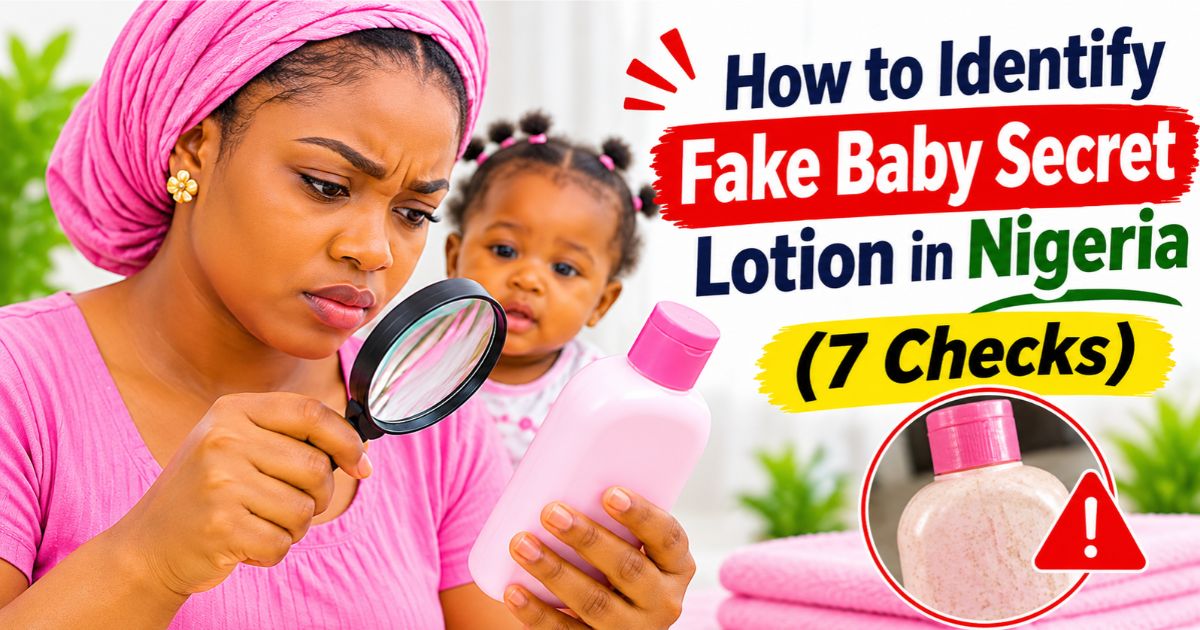
Fake Baby Secret Lotion is becoming common in Nigerian markets and online stores, and using it on your baby’s delicate skin can cause rashes, irritation, and other health problems. The good news is that you can spot a fake before it touches your child. In this guide, you will learn 7 simple checks, from the NAFDAC number and batch code to packaging quality, smell, texture, price, and seller reliability, so you can buy with confidence and keep your baby safe.
Why Fake Baby Lotion Is a Real Risk in Nigeria
Fake cosmetics are not rare, and they are not always sold by obvious scammers.
In a raid reported in 2025, NAFDAC seized ₦500 million worth of illegal cosmetics. Counterfeiters import or copy containers, refill them with fake creams, and sell them through informal markets.
In February 2026, NAFDAC uncovered a warehouse at the APT Trade Fair Complex in Lagos holding banned, fake and unregistered cosmetics worth over ₦3 billion.
Here is the part that matters to you: a good-looking bottle is not proof of a good lotion. If fakers can reuse or copy the container, the outside can pass while the inside is something else.
That’s why this guide checks more than the label. It checks the pack, the proof and the place you bought it.
7 Checks to Tell Original from Fake Baby Secret Lotion
No single check settles it. Run all seven, and treat two or more red flags as a reason to stop.
1. Check the NAFDAC number (and verify it)
Find the NAFDAC registration number on the pack. Then look it up. Don’t just read it.
Why? Because a printed number is not proof. NAFDAC itself has admitted that fake registration numbers are in circulation.
What to do:
- Note the number exactly as printed.
- Search it on NAFDAC Greenbook or the NAFDAC verification page.
- Make sure the product name and company match what’s on your bottle.
- If nothing comes up, or the details don’t match, treat it as a red flag.
2. Inspect the label, cap, pump and seal
Hold the bottle in good light. Compare it with a pack you trust, or with the brand’s official photos.
Look for:
- Blurry, smudged or misspelled text
- Colours that look faded or slightly “wrong”
- A loose, cracked or badly fitted cap or pump
- A missing or broken tamper seal
- Labels that peel easily or sit crooked
3. Read the batch number and expiry date
Every genuine product should carry a batch number, a manufacturing date and an expiry date.
Check that:
- All three are present and readable
- They look printed or stamped the same way as on other bottles of the same batch
- The dates make sense (an expiry date that is years away on a “new” batch is odd)
Be careful here too. A fake can copy a code, so a batch number helps you spot sloppy fakes, but it doesn’t prove a bottle is real.
4. Smell, texture and separation (with honest limits)
Squeeze a small amount onto a clean surface. Look and smell.
Watch for:
- A strong, harsh or chemical smell
- Watery, lumpy or gritty texture
- Oil and water layers separating
- A colour that differs from your last bottle
These signs are useful, but never rely on them alone. A fake can smell nice, and a real product that’s been stored in heat can change too. Use this check to support the others, not replace them.
5. Compare against the brand’s official product
Put your bottle next to a pack you know is genuine, or the images and details the brand publishes.
You’re looking for small differences: font, spacing, logo shape, size, weight. Fakes often get the big picture right and miss the details.
6. Check the price
A very low price is a classic warning sign. If a seller offers “original” Baby Secret far below what pharmacies and official stockists charge, ask why.
That said, a normal price doesn’t prove anything. Fakers can price at the market rate too. Use price as a clue, not a verdict.
[BRAND INPUT: the current typical price range in naira, if you want to publish one.]
7. Check where you bought it
This one catches more fakes than any other. Ask yourself:
- Is the seller a registered pharmacy, supermarket or authorised stockist?
- Does the seller have a shop, a phone number and a track record?
- Would they give you a receipt?
Be more careful with anonymous WhatsApp sellers, unverified online listings and unregulated stalls. NAFDAC has warned that counterfeiters can exploit the trust people place in busy market spaces.
Original vs. Fake: Quick Comparison Table
| What to check | What you should see | Red flag |
| NAFDAC number | Present, and it checks out on NAFDAC’s system | Missing, or fails verification |
| Print and label | Sharp, even, correctly spelled | Blurry, uneven, spelling errors |
| Cap, pump, seal | Firm, intact, matches the official pack | Loose, cracked, no seal |
| Batch and expiry | All present, clear, consistent | Missing, smudged, odd dates |
| Smell and texture | Smooth, consistent, similar to what you know | Harsh smell, lumpy, separated |
| Price | In line with trusted stockists | Far below normal |
| Seller | Registered pharmacy or authorised stockist | Anonymous or unverified |
[BRAND INPUT: replace general descriptions with Baby Secret-specific details once supplied.]
Where to Buy Original Baby Secret Lotion Safely
You can lower your risk a lot by choosing where you shop.
- Buy from registered pharmacies and established supermarkets. They have more to lose from selling fakes.
- Ask for a receipt, and keep the bottle’s outer packaging.
- Use the brand’s own list of stockists. [BRAND INPUT: official stockist or “where to buy” link.]
- Be careful with online marketplaces. Check seller history, reviews and return options before paying.
- Don’t buy “special offers” from strangers who message you directly.
One more thing: a barcode scan won’t settle it. Barcodes identify a product type and manufacturer, not whether the individual item is genuine.
Can Fake Baby Lotion Harm Your Baby’s Skin?
Yes, it can. Fake products haven’t been tested or approved, so no one knows what’s in them or whether they’re clean.
Possible effects include:
- Redness, rash or itching
- Dry, flaky or irritated skin
- Swelling or hives (see a doctor right away)
- Skin infection, if the product was contaminated
Baby Can I Use Body Treat Lotion absorbs and reacts more easily than adult skin, so even a mild-looking reaction deserves attention.
If your baby has a severe reaction, such as swelling, trouble breathing or widespread hives, go to a hospital immediately. For milder reactions, stop using the lotion and speak to a pediatrician.
What Should You Do If You Bought a Fake?
Stay calm and follow these steps:
- Stop using it right away.
- Gently wash your baby’s skin with clean water and a mild cleanser.
- Keep the bottle, the box, the receipt and any messages from the seller. Take clear photos of the label, NAFDAC number, batch number and expiry date.
- Contact a pediatrician if there is any rash, swelling or discomfort.
- Report it to NAFDAC. The complaints line is 0800-1-NAFDAC (0800-1-623322), and reports can also go to sf.alert@nafdac.gov.ng. Say where you bought it.
- Tell the seller you want a refund, and warn other parents if it was an online purchase.
Reporting matters. Every report helps NAFDAC track where fakes are being sold.
The 3-Layer Check: Pack, Proof, Place
Seven checks are a lot to remember. So here’s a simple way to hold them in your head: Pack, Proof, Place.
- Pack: Does the bottle, label, cap and seal look right?
- Proof: Does the NAFDAC number actually verify, and are the batch and expiry details clear?
- Place: Did you buy it from a seller you can trust and trace?
A real product passes all three. A fake usually fails at least one, and the more layers it fails, the more likely it is counterfeit.
If you can only do one thing in a hurry, check Proof and Place. Those are the layers fakers find hardest to copy.
Conclusion
Fake Baby Secret Lotion is a real risk in Nigeria, but you can protect your baby with a few simple checks. Always inspect the packaging quality, batch number, NAFDAC number, expiry date, smell and texture, price, and the seller’s reliability. If even one of these looks suspicious, do not use the product on your baby’s skin. Buy only from trusted stores or the official brand, and report any fake product to NAFDAC.
FAQs
How can I tell if my Baby Secret lotion is original?
Check the NAFDAC number (and verify it), the print quality and seal, the batch and expiry details, and where you bought it. Compare the bottle with an official pack. If two or more checks fail, stop using it.
Is a NAFDAC number on the bottle proof that it’s real?
No. Fake registration numbers exist. Always verify the number on NAFDAC’s system and confirm that the product name and company match the pack.
Can fake baby lotion harm my baby?
It can. Fakes are untested, so they may cause rashes, irritation or infection. If your baby reacts, stop using the product and see a pediatrician.
Does a barcode prove the lotion is genuine?
No. A barcode identifies the product type and manufacturer. It doesn’t prove that a specific bottle is real.
Where can I report fake baby lotion in Nigeria?
Call NAFDAC on 0800-1-NAFDAC (0800-1-623322) or email sf.alert@nafdac.gov.ng. Share where you bought it and send photos of the pack and batch details.
What should I do if I already used a fake lotion on my baby?
Stop using it, wash the skin gently, keep the bottle and receipt, and contact a pediatrician. Report it to NAFDAC.


