

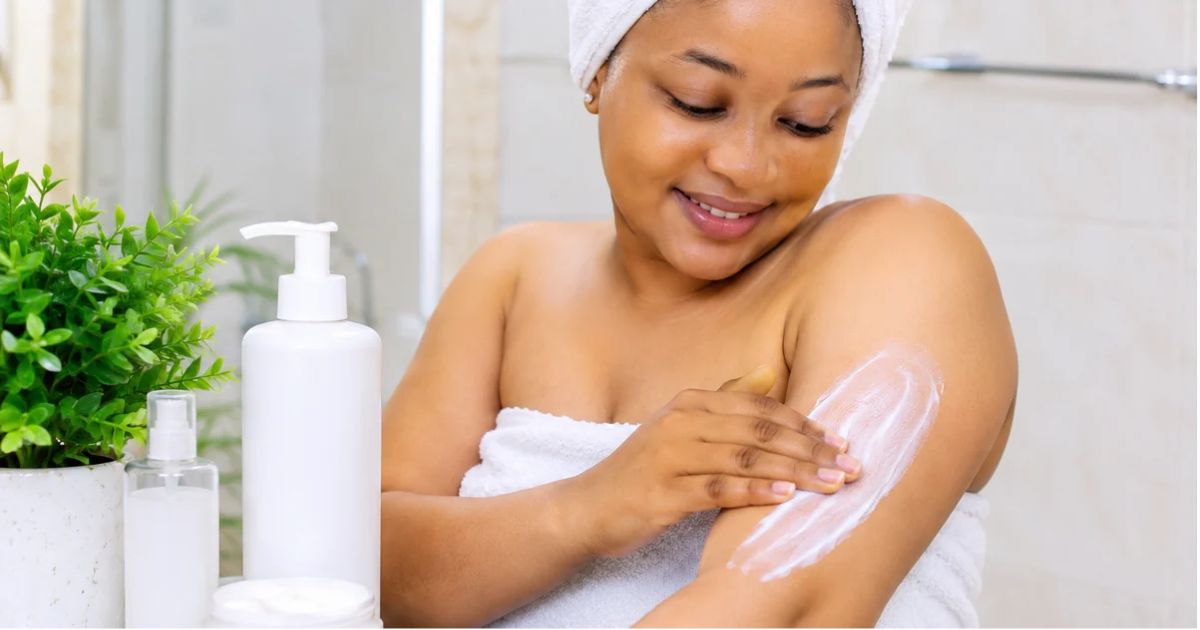
No lotion can whiten your skin permanently. A good brightening body lotion can fade dark spots and even out your tone, slowly, and only while you keep using it with sunscreen. The safest choice is a NAFDAC-registered product with a full ingredient list and no mercury, steroids or high-dose hydroquinone.
Is there a permanent skin whitening body lotion?
No. No body lotion can permanently whiten skin. Your natural skin tone is set by genetics, and melanin production continues as long as you live. Lotions can fade dark spots and even your tone for as long as you keep using them, but results fade if you stop or skip sunscreen.
That’s not just opinion. Healthline notes that aside from sunscreen and limiting sun exposure, you can’t lower your body’s overall melanin production, and permanent reduction isn’t advised because melanin formation is determined by genetics.
Why melanin can’t be “switched off”
Melanin is the pigment that gives your skin its colour. It also shields you from the sun. Everyone has about the same number of melanin-making cells; some people’s cells simply make more of it.
A lotion can slow melanin production in a spot for a while. It can’t rewrite your DNA.
What “permanent” claims usually hide
There is one exception, and it’s not a lotion you’d want. The only known permanent over-the-counter option is monobenzone, used for extreme vitiligo, and it isn’t recommended by the FDA.
So when a product says “permanent whitening,” one of three things is usually true:
- It’s an exaggeration. The lotion just brightens a little.
- It contains a harsh ingredient. Think mercury, steroids or too much hydroquinone.
- It’s a scam. The bottle is fake or the claim is made up.
The second one is the dangerous one. Dermatologists quoted in Vanguard say there is no safe bleaching cream, and that products sold as toning, glowing, organic or herbal often hide steroids, hydroquinone, mercury or other harmful agents.
One risk deserves a special warning. Exogenous ochronosis is a darkening of the skin from some lightening products that can be permanent and very resistant to treatment. That is the opposite of what you wanted.
My view: Chasing “permanent” is the fastest way to end up with skin that is thinner, blotchier or darker than where you started. Chase “even, healthy and glowing” instead. That’s achievable.
Whitening vs brightening vs bleaching what’s the difference?
These words sound alike but mean different things. Brands blur them on purpose.
Brightening means improving dullness and making skin look more radiant, often by exfoliating and adding antioxidants.
Lightening means reducing excess pigment in darker areas so your skin tone looks more even.
Bleaching means using strong agents to lower pigment across large areas. This is where most of the harm happens.
| Term | What it aims to do | Typical risk level |
| Brightening | Reduce dullness, add glow | Low (with sun protection) |
| Lightening / tone-evening | Fade dark spots and uneven patches | Low to moderate |
| Bleaching / “whitening” | Lower pigment broadly | High, especially with unregulated products |
A good rule: if a product promises a dramatic colour change in days, treat that as a warning, not a selling point.
Is skin lightening legal and safe in Nigeria?
Nigeria has rules. They just aren’t always enforced well, so you have to protect yourself.
The scale of demand explains why. A Nigerian minister, citing WHO, said 77% of Nigerian women use skin-lightening products, making Nigeria the highest consumer in the world.
What the rules say
- Nigeria’s 2019 cosmetics regulations on bleaching agents ban harmful substances like mercury and cap hydroquinone at 2%.
- Nigeria is also bound by the Minamata Convention, which requires banning the manufacture, import and export of cosmetics with more than 1 part per million of mercury.
- A NAFDAC official has warned that hydroquinone above 2% in cosmetics is harmful and linked to serious conditions.
Why you still can’t relax
Rules on paper don’t equal safe shelves. The minister admitted that smuggling, online sales and weak enforcement remain big problems.
One investigation tested creams and found worrying results. Nine creams (about 9.5%) contained mercury at levels more than 100,000 times the allowed limit, and 68% of the non-compliant creams were bought online.
Even well-known names have been flagged. NAFDAC publicised an EU recall of Caro White Skin Lightening Beauty Lotion. The reported concern was kojic acid above the EU’s 1% limit.
Note for the editor: Before publishing, confirm the current NAFDAC alert status of any product named here. Alerts change.
Ingredients that actually work (and how long they take)
Safe brightening ingredients work in a different way from bleaching agents. They are gentler and slower.
| Ingredient | What it does | Typical timeline | Watch out for |
| Niacinamide | Slows pigment transfer into skin cells | Roughly 4–8 weeks at 5–10% for uneven tone | Mild irritation in some people |
| Vitamin C | Antioxidant that helps limit melanin formation | Visible change in about 4–8 weeks; deeper spots can take 3–6 months | Unstable in bad packaging; can sting |
| Alpha arbutin | Slows the enzyme that starts melanin production | Described as the gentlest option, often paired with niacinamide | Needs patience |
| Licorice extract | Soothing, mild tone-evening | Gradual | Less proven than the others |
| Lactic acid (mild AHA) | Gentle exfoliation to lift dull surface cells | Weeks | Sun sensitivity; use SPF |
| 4-butylresorcinol | Pigment-slowing agent | Gradual | Listed in some mainstream lotions; check the full formula body lotion for dark spots india +2 |
Ingredients to treat with caution
- Hydroquinone: legal in Nigeria only up to the limit, and better under a dermatologist’s care.
- Kojic acid: can irritate at high levels, as the Caro White case shows.
- Mercury compounds and steroids: avoid completely.
Glutathione lotions: Many Nigerian listings push these for “fast results.” I couldn’t find solid evidence that topical glutathione works that way. Treat the claim with scepticism until a source says otherwise.
Which body lotions are worth considering?
I can only vouch for products whose formula I could see. Use this table as a starting point and verify each one yourself.
| Lotion | What the label/page shows | Good to know |
| NIVEA Radiant & Beauty Even Glow (400 ml) | A full ingredient list including 4-butylresorcinol, ascorbic acid and sodium ascorbyl phosphate, plus SPF 15, for dry to very dry skin. | NIVEA says it brings out your natural glow without altering your complexion. A transparent ingredient list is a plus. |
| NIVEA Perfect & Radiant (formerly Natural Fairness) | A milder everyday formula using licorice and berry extracts, aimed at keeping tone consistent without aggressive lightening. | Better for gentle maintenance than for stubborn spots. |
Indicative prices: One Nigerian retailer review puts a 400 ml bottle at about ₦4,500–₦6,500 for Even Glow and ₦3,200–₦5,800 for Perfect & Radiant. Prices change, so check before you buy.
Brands to read carefully before buying
- Fair & White: formulas differ by variant and market. An international listing for one Exclusive lotion cites alpha arbutin and glycerin. A Nigerian pharmacy listing for another Exclusive variant says it contains hydroquinone. Always read the exact variant’s label and NAFDAC number.
- Caro White: see the NAFDAC-publicised recall above.
Editor’s note: Add 3–5 more products only after you’ve confirmed each one’s NAFDAC registration number and current ingredient list. I haven’t verified others here, so I’m not naming them.
The 5-Point Label Test
Here’s a quick method you can use in a pharmacy aisle. Run any lotion through these five checks.
- A NAFDAC number you can verify. Look it up on NAFDAC’s official product database before you buy. (Confirm the current official link before publishing.)
- A full ingredient list. If there’s no list, walk away. NAFDAC’s director-general and the NHS both flag a missing ingredient list as a red flag.
- No red-flag activities. Avoid mercury compounds, steroid names and hydroquinone above 2%.
- Sun protection. Either the lotion has SPF, or you add a separate sunscreen. One body-lotion guide says daily sunscreen matters more than which lotion you pick.
- A believable claim. Be wary of “7-day whitening” or “permanent.” Real tone-evening is slow.
Score it out of five. Anything below four stays on the shelf.
How do I check if a lotion isn’t fake?
Counterfeits are common. A fake can contain anything.
Do these checks:
- Buy from a verified seller. Avoid unbranded online sellers and open-market stalls.
- Use the brand’s verification tools. Nature Glow Paris bottles carry a scratch-to-verify SMS code, so check the panel is intact. NIVEA Nigeria invites buyers to send photos of the front, back and bottom of a bottle to verify authenticity.
- Compare the bottle to the brand’s official images. Look at print quality, batch codes and seals.
- Be suspicious of prices far below normal. Cheap “original” imports are often fake.
How to use a brightening lotion properly
- Patch test first. Dab a little on your inner arm for 24 hours. If it itches, burns or reddens, stop.
- Apply to clean, slightly damp skin, ideally right after a bath.
- Massage until absorbed, and focus on the areas you want to even out.
- Use it every day. Consistency matters more than amount.
- Add sunscreen in the morning on exposed skin, even on cloudy days.
- Skip harsh scrubs. They can cause the dark marks you’re trying to fade.
How long until I see results?
Most people need 4–12 weeks to see a visible change from a safe brightening lotion, and body skin is often slower than face skin. Judge a lotion at about 12 weeks, not after two.
Here’s why. One body-lotion guide says forearms and shins may look more even after 12 to 22 weeks of steady use, and suggests judging a lotion at 12 weeks. Darker skin tones may see slower initial results but often achieve good long-term outcomes with patience.
A realistic 12-week timeline
| Weeks | What to expect |
| 1–2 | Smoother, better-hydrated skin; no real tone change yet |
| 3–6 | Early glow; surface dullness lifts |
| 7–12 | Dark spots begin to soften if you’ve used it daily with sunscreen |
| 12+ | Judge honestly; take a photo in the same light as week 1 |
Take a weekly photo in the same spot, same light. Your eyes lie. Photos don’t.
Who should skip these lotions?
Talk to a doctor or pharmacist first if any of these apply to you:
- You’re pregnant or breastfeeding. GoMed’s page for Caro White advises against use in pregnancy or breastfeeding and suggests consulting a healthcare provider. Ask your doctor about any brightening lotion.
- You have very sensitive or broken skin.
- Your dark patches are on your face and look symmetrical, which can be melasma.
- A patch gets darker, bluish or thicker after using a product. Stop and see a dermatologist.
When to see a dermatologist
A lotion isn’t the only route. If you have stubborn patches, a dermatologist can look at the cause and choose treatments such as prescription products, peels or light-based procedures, with proper supervision.
This is the safest way to treat pigment problems that don’t respond to over-the-counter products. It also protects you from guessing.
What I’d tell a friend (Expert insight)
[Placeholder for the brand: insert a dermatologist or pharmacist reviewer’s name and credentials, plus 1–2 first-hand observations, for example a 12-week photo log from real customers. This section is the strongest E-E-A-T asset on the page. Don’t publish invented testimonials.]
If a friend asked me, I’d say this: pick a gentle lotion with niacinamide or vitamin C, use sunscreen every morning, and take a photo every week. If nothing changes in 12 weeks, don’t switch to something harsher. See a dermatologist.
Conclusion
Permanent skin whitening isn’t something anybody in Nigeria can safely deliver. Products that promise it often hide steroids, mercury or high-dose hydroquinone, which can thin your skin, cause dark patches and lead to serious health problems. The safer route is to aim for brighter, more even skin by using sunscreen daily, choosing NAFDAC-registered lotions with proven ingredients like niacinamide, vitamin C or kojic acid, and seeing a dermatologist for stubborn dark spots. Real results are gradual, and they last only as long as you protect and care for your skin.
FAQs
Is there a permanent skin whitening lotion?
No. Genetics sets your base skin tone, and no lotion can permanently change it. Lotions can fade dark spots and even your tone only while you keep using them.
Is skin whitening lotion safe?
It depends on the ingredients. Lotions with niacinamide, vitamin C or alpha arbutin are generally gentler. Products containing mercury, steroids or high-dose hydroquinone are unsafe.
Is hydroquinone banned in Nigeria?
Not entirely. Nigerian regulations limit hydroquinone to 2% in cosmetics and ban mercury. Use it only under a doctor’s guidance.
How do I know if a lotion is NAFDAC-registered?
Find the NAFDAC number on the packaging and check it against NAFDAC’s official database. If the number is missing or doesn’t match, don’t buy.
How long does a brightening lotion take to work?
Expect about 4–12 weeks for visible changes. Dark spots on the body can take longer.
Does Nivea lotion lighten skin?
NIVEA says its Radiant & Beauty Even Glow brings out your natural glow without altering your complexion. It aims to even tone rather than lighten you dramatically.
Can I use a brightening lotion while pregnant?
Ask your doctor or pharmacist first. Some products have been advised against during pregnancy.


